
7 reasons people who switched everything else to natural fibre are switching their gym shirt to 100% merino
You switched the bedding, the pyjamas and the underwear. The gym shirt stayed polyester, because cotton stays drenched and the merino you found was a blend. Seven reasons this one works for training, and the full specification.

It usually starts at the drawer. A shirt inside out, the tag between your fingers, reading the composition line properly for the first time. Polyester. The next one: polyester. The one you paid real money for because the front said merino: a blend, once you read the tag.
If you have got this far, you know the sequence. Bedding went first, because it touches skin all night. Then pyjamas, then underwear. You started opening the composition tab in another window before you looked at the price. Somebody at home started calling it the hunt. And the gym bag stayed exactly as it was, because it is the expensive section, you did not know which brand to trust, and the whole category seemed to be plastic by definition.
“My workout wear is the last section for me to get to because I didn’t know which brand to try and they’re so expensive.”
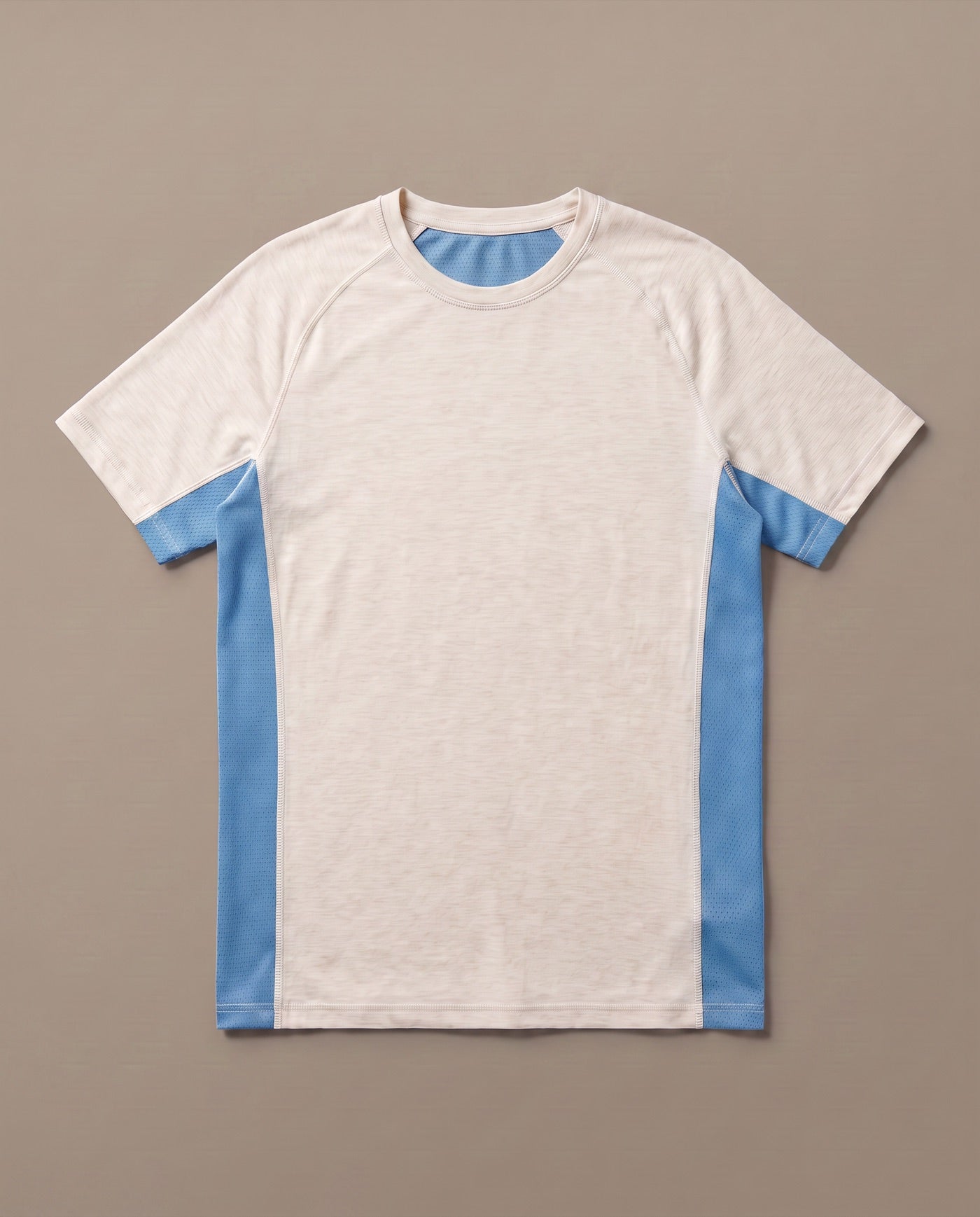
This page is for that last section. The PRFORM Apex tee is a training shirt made of one fibre, 100% merino wool, mesh panels included, made for exactly that last section. We are new, so there are no customer reviews on this page and we will not invent any. Here are the seven reasons, starting with why the natural options you tried did not work for training.
Cotton stays drenched, “merino” blends are part plastic, and thin merino holes. This tee was built against all three.
If you have tried to leave polyester, you have probably been through this sequence, in this order.
Cotton. An honest fibre and a good one. It is just not what most people want to train in, and it was never sold as a training fabric. Nothing wrong with it. Wrong hour.
The “merino” blend. You go looking for merino, flip the care label, and find a blend. One buyer’s words: “sure, the wool they used was 100% merino, but the garment itself was 47% Nylon and feels and wears like scratchy polyester”. Another found “about 12% nylon” in the merino she had worn for years. The activewear industry heard that people wanted out of plastic, and sold them plastic with wool on the label. Part plastic, in other words. Our rule is simple: 100%, or it is a blend.
The thin merino tee that did not last. The $160 tee with holes inside a year is a real story, and it has a cause. An ultralight knit, worn under pack straps and on gym benches, washed in a biological detergent. Biological detergents contain protease, an enzyme made to digest protein stains. Wool is protein. Wash it in that, warm, every time, and the fibre thins until it opens.
“I only buy 300 gram per meter merino anymore because anything less just doesn’t last.”
“$85 for a t-shirt is so cost-prohibitive for most people, and so many of the wool clothing online also has nylon and spandex in it anyway.”
Call it the activewear compromise. Every “natural” gym shirt we could find cheats on one of three lines: the fibre (a blend), the weight (an ultralight knit that opens within a year), or the care (no instructions, so it goes in with the bio detergent and dies). Fix one and the other two still get you.
So this tee was built against all three: one fibre at 17.5 micron, a 160-gram training knit rather than an ultralight, and the care line stated on this page and on the product page.
The specification, in full: 100% merino, 17.5 micron, 160 g/m², merino mesh
This is why PRFORM exists. One shirt, one fibre, and a composition line that reads the way the forums said it should. Here is what the shirt is, line by line. Each one is a fact about the shirt, not a claim about you.
- 100% Australian merino woolOne fibre on the label. No polyester, no nylon, no elastane.
- Ø 17.5 micronSuperfine, the grade for bare skin. Reads as soft, not as wool.
- 160 g/m²A training weight. Light enough for the session, warm enough at rest.
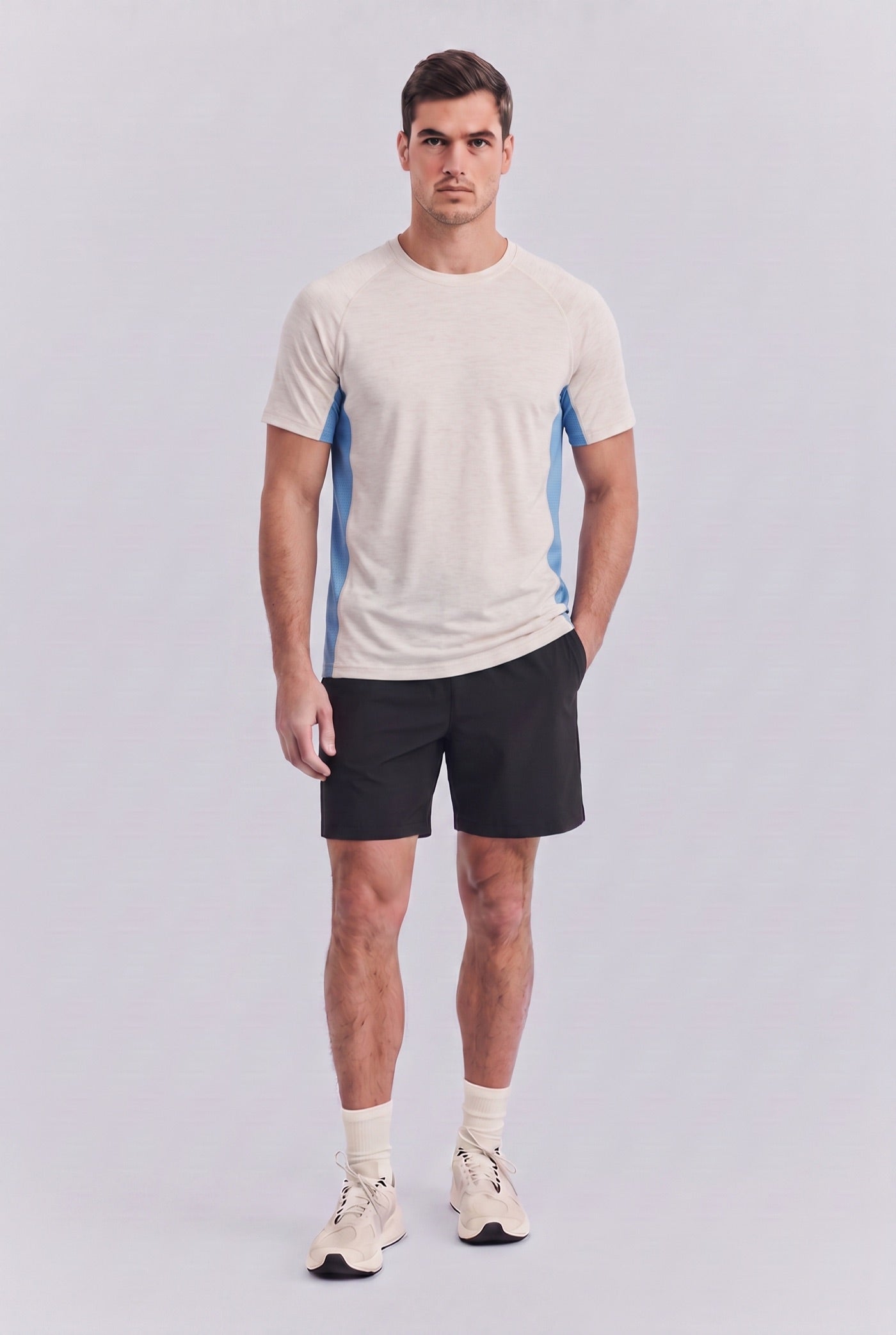
- Merino mesh panelsAirflow where you heat up, still one fibre.
- Wash cold, non-bio, hang to dryThe care line that keeps a merino tee whole.
- Designed in NorwayBuilt for training, worn everywhere.
The smell that survives the wash lives in polyester. Merino lets it go overnight.
You know the shirt. It comes out of the machine smelling of nothing, and ten minutes into the warm-up it is back. The mechanism is not a mystery. The oily compounds your skin produces when you sweat bind to the surface of plastic fibres, and washing struggles to pull them back out.
Researchers at Ghent University found that after a spin class, polyester shirts smelled significantly more intense and less pleasant than cotton shirts, with odour-associated bacteria growing almost only on the polyester (Callewaert et al., Applied and Environmental Microbiology).
University of Alberta researchers found polyester released the highest intensities of odorous sweat compounds after 24 hours, while wool and cellulosic fibres released less after three hours (McQueen et al., Textile Research Journal). Funded by a national science council, not a wool board.
So if you have ever quietly suspected your washing machine, your detergent or your own body: it was never any of those. The smell lives in the fibre, and the people who train in it worked that out years before any brand said it out loud.
“Polyester smells like death after one gym session and I’m done with it.”
“Marketing gaslighting makes people belive that if their clothing stinks, that means that there is something wrong with THEM [...]”
“I didn’t know that polyester binds to fatty acids, that explains a lot!”
The internet has a whole folklore for fighting it. Vinegar soaks, sport detergents, strip washing, sixty-degree cycles the label warns against, the freezer trick. Some of it helps for a wash or two. None of it holds, because none of it changes the surface the compounds bind to.
Wool works the other way round. It takes the compounds into the fibre and lets them go as it airs, which is why merino wearers hang a shirt up at night and put it back on in the morning. Train Monday, hang it up, train Wednesday in the same shirt, and nobody at the next bench knows.
Read our label
900 kr for one tee, and it replaces a drawer of them
Flip the label on a $150 “technical” tee and on a $15 one from a fast-fashion site. The same polyester. Most of what you pay for in tech wear is the story, and the forums worked that out before we did:
“‘Tech wear’ is a way for brands to sell cheap polyester at high margins, change my mind.”
Ours is 900 kr, more than a polyester tee, and here is what the money buys. Superfine merino at 17.5 micron, which is the expensive end of wool. One shirt that trains all week and gets washed on Sunday, so it replaces a drawer of tees rather than joining it. Put it next to what it replaces: the $160 merino tee that holed, the polyester tees you rebuy every year, the arsenal under the sink. And doing nothing costs the same hour of plastic every session, plus the rebuys.
The return: 30-day returns, unworn and with the tags on. Read the label and try the fit at home. If either is wrong, send it back with the prepaid label.

The label says polyester, which is plastic. Ours says one word: merino.
Polyester is PET, the same polymer as the bottle in your gym bag, drawn out into thread. Nylon and elastane are plastics too. It does not feel like plastic, which is exactly why nobody thinks about it. The fibre is soft, the marketing says “technical”, and the word plastic appears nowhere.
Put a normal training outfit together and you are wearing plastic on most of your skin for the hardest, sweatiest hour of your week. Three or four times a week. For years. It is the one place the plastic-free rule you apply everywhere else quietly does not apply.
The PRFORM tee’s composition line is one word long. Merino. No polyester, no nylon, no elastane. Nothing on the label you would throw out of your kitchen.
Meet the fibre.
Grown, not extruded. Everything below is what it does.
Heat and sweat move what is in a fabric, so the training hour is the one to fix first
Most people who started taking plastic out of their lives did it in the kitchen first. Glass instead of containers, a steel bottle, no receipts, no microwaving in plastic. Clothing tends to sit at the bottom of that list, and training clothes barely make it on at all. The research says that is the wrong order.
Scientists at the New York State Department of Health found bisphenol A in 82% of 77 clothing and textile samples tested, with the highest level in a 97% polyester sock (Xue et al., Environmental Science & Technology).
Laboratory studies show that bisphenols and antimony present in clothing migrate into artificial sweat, and that antimony release from polyester rises with temperature (Biver et al., Regulatory Toxicology and Pharmacology, 2021; Jurikova et al., Environmental Science and Pollution Research, 2024).
Here is what those studies do not say, because we will not pretend otherwise: nobody has shown that a shirt changes your hormones. What they say is narrower and harder to argue with. The compounds are in the fabric, and heat and sweat move them. Training is the one hour a day when a shirt is hot, wet and pressed against you.
PRFORM started with a contradiction. I had taken plastic out of my kitchen, out of my water bottle, out of most of my life, and I was still putting it on for the one hour a day I sweat hardest, then heating it against my skin. I built the shirt I could not find.
So this is the shirt for that hour: one fibre that grew, worn against the skin you are heating. It takes that line off a list you are already keeping.
Where plastic holds the sweat compounds at its surface, wool takes them into the fibre and lets them go as it airs. So the routine flips. You stop fighting the shirt and start ignoring it:
The session does its worst.
Air is the wash cycle.
Ready before you are.
What to expect in week one: it will feel like a normal tee, not like wool. It will spend more nights on a hanger than in a machine. And the first wash is cold, with a non-bio detergent, and no dryer.
The itch your childhood remembers was coarse wool. Irritation tracks fibre diameter, and ours is a superfine 17.5 micron fibre. And 160 grams per square metre is a deliberate number: the weight you want on a bench or a run, not the 300-gram winter base layer you would wear under a shell. If you want the heavier one, that is the quarter-zip, at 210.
“Merino you can still wear for a month straight with gross sweat and it miraculously doesn’t stink.”
“Cotton wore out, polyester smelled, merino simply works.”
The four questions everyone asks before they buy
Straight answers, including the one that loses us a few sales.
Will it survive the gym?
“After a year my $160 dollar t-shirts self destructed with holes and the shirts were then of no use.”
That is the fear, and it is earned. Any 160-gram knit wears where it is rubbed hardest, and the two things that open a merino tee early are abrasion under pack straps and enzyme detergents, which digest protein. So the care line is on this page and on the product page.
Isn’t wool hot?
“Lol wool is warm wet or dry , cool in the summer and warm in the winter [...]”
We answer it with a weight, not with physics. 160 grams per square metre is the light end of merino, a training weight. And the honest limit: if you run very hot at very high output, a merino tee is not your fastest-drying option, and we would rather say so here than in a returns email.
There is no elastane. Does it move?
“100% wool is still not great for something fitted that needs really good recovery.”
True, and we did not build a fitted one. This is a knit, so it stretches with you and comes back, and the mesh panels are knit more open where you heat up. It is cut as a training tee, not as compression. If you want a compression fit, this is the wrong shirt, and we would rather lose the sale than the trust.
How does it fit, and what if it does not?
The cut is athletic and it comes in S, M, L and XL. If you are between sizes, take the larger one. It ships from Norway. And the return is simple: 30-day returns, unworn and with the tags on. Try the fit at home, read the label, and if either is wrong send it back with the prepaid label.
Polyester sheds plastic every wear. Wool sheds wool.
Researchers at the University of Plymouth and Italy’s National Research Council found that polyester garments release microfibres into the air simply by being worn, in yearly quantities of the same order as those released to water by washing (De Falco et al., Environmental Science & Technology, 2020). Not just laundry day. Every day.
Every fibre sheds, wool included. The difference is what happens next. Wool is a protein and breaks down. Polyester fragments and stays, in waterways, in house dust, and, according to the newer research, in us. It is worth reading exactly as published:
Ragusa and colleagues reported microplastic particles in human placentas, in the journal Environment International.
Leslie and colleagues at Vrije Universiteit Amsterdam measured plastic particles in human blood for the first time, in most of the donors they sampled.
Marfella and colleagues, in the New England Journal of Medicine, followed patients who had plaque removed from their carotid arteries. The patients whose plaque contained microplastics had markedly worse cardiovascular outcomes over the following three years than the patients whose plaque did not.
Here is where the science actually stands: nobody has traced the route in, and nobody has proven it safe. The researchers finding these particles are still asking the question. Your training kit is not waiting for the answer. So we made the call early: not our sportswear. Not out of plastic. What this shirt sheds is wool. If the research lands harmless, merino cost you nothing. If it lands the other way, you were out years ahead of the headline.
The two fibres, side by side
Strip the marketing off both and this is the comparison that is left.
Polyester
- holds the odour compounds longest of the fibres measured
- sheds plastic every wear and every wash, and the plastic stays
- back in the machine after every single session
Merino
- takes odour compounds in and lets them go as it airs
- sheds wool, which is protein and breaks down
- hang it up tonight, wear it again tomorrow
Smaller questions
Is merino itchy?
Itch tracks fibre thickness, and ours is superfine: 17.5 micron. If your reference is a school jumper, this is a different material in everything but name.
How do I wash it, and how often?
Far less than you think. Hang it up at night and the shirt resets itself; train in it all week, wash it on Sunday. When you do: cold, a non-bio detergent, no dryer. Biological detergents contain protease, which digests protein, and wool is protein.
Why not just cotton?
Nothing wrong with cotton. We built this for the hour most people did not want to spend in it: the session. If you train in cotton and like it, you do not need us.
What are the blue panels?
Merino mesh, knit more open where you heat up. Still one fibre: no polyester, no nylon and no elastane on the label.

The Merino Tee
One shirt with a label you can read in full. Knit in a single fibre, designed in Norway for people who train, and for the days between.
“[...] cleaner clothes are frequently un comfortable or very expensive and don’t come in gym versions lol”This is the gym version.

The Merino Tee
100% superfine merino wool, 17.5 micron, 160 g/m². No polyester, no nylon, no elastane. Air it overnight, wear it again. It costs more than a polyester tee, and it replaces a drawer of them.
Two ways this goes
You can keep the exception: the one drawer where the plastic-free rule does not apply, the sniff test, the tag you have stopped reading because you know what it says. Or you can read one care label that finally says a single word, and close the list. That is the whole decision.
Get the tee 30-day returnsQuotes on this page are from public forums and comment sections about synthetic and natural fibres in general, lightly trimmed for length. Studies are cited as published; none of them tested this shirt.